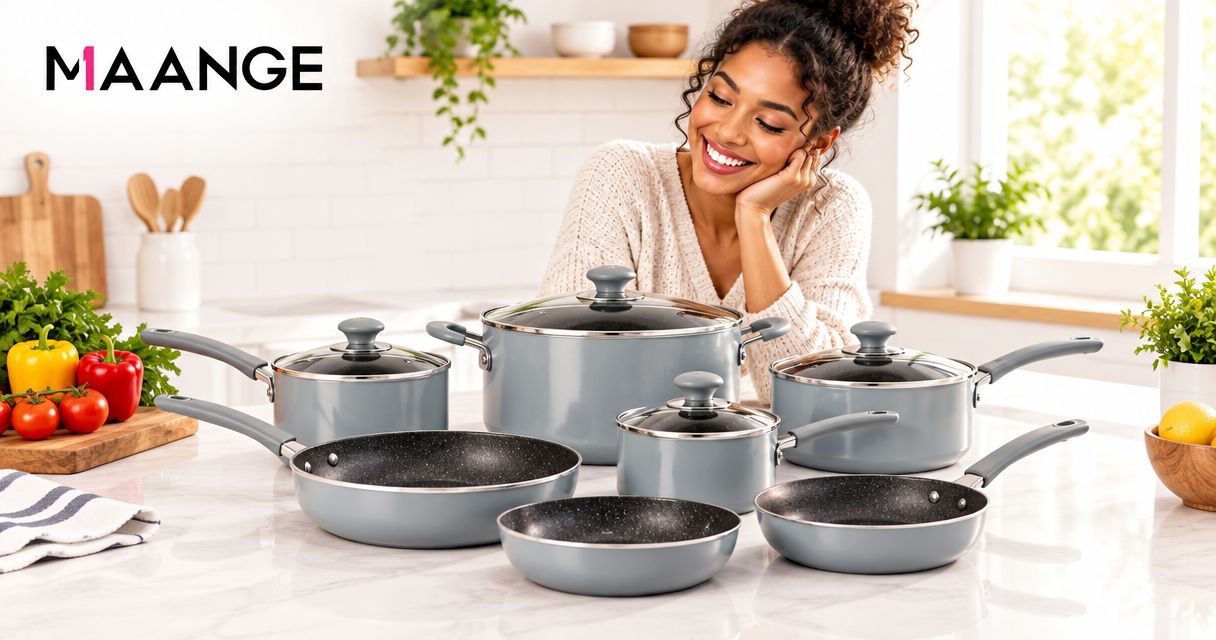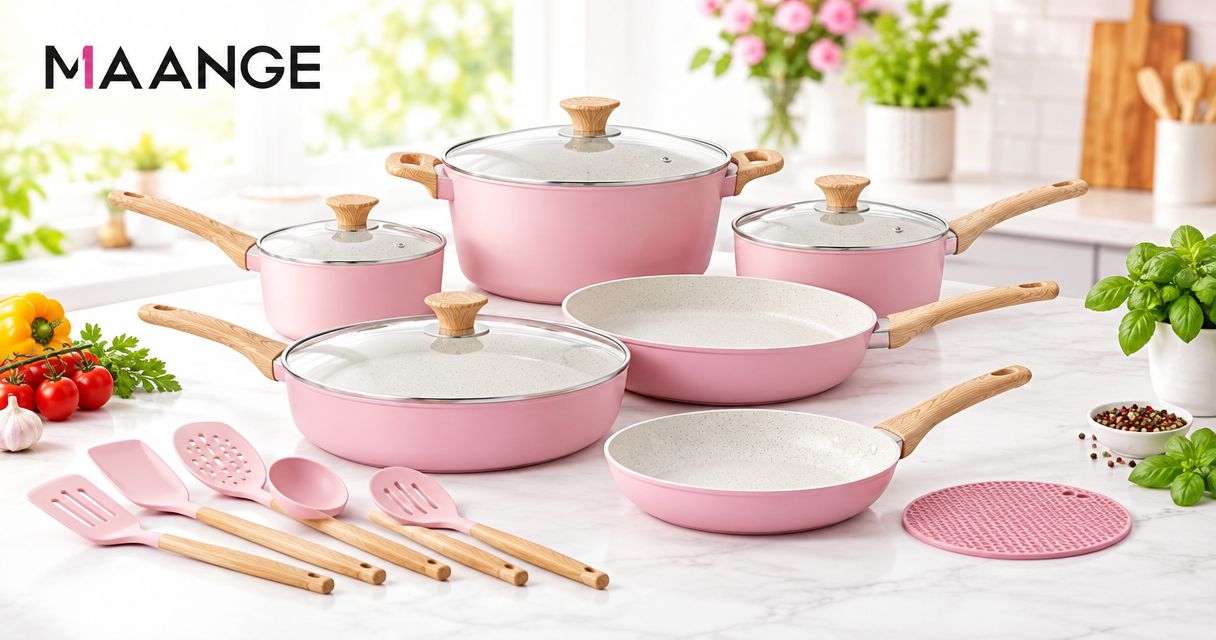
A 12 piece cookware set counts the individual items included in the package, not necessarily 12 pots and pans: lids, utensils, and other listed accessories can each count as a piece. A pot with its separate lid therefore contributes 2 pieces, while an attached handle is part of the pot. To know what you can actually cook with, separate the cooking vessels from everything else on the contents list.
- A 12 piece cookware set does not necessarily contain 12 pots and pans.
- Separate lids can count as pieces; attached handles are parts of the cookware.
- Compare cooking vessels, lid fit, and accessories rather than the headline count.
- VanityWalker suits everyday shoppers who want beauty and home essentials in one store.
Why this matters
A matching lid is useful, but it cannot replace another saucepan when you need to cook two foods separately. A spatula helps you turn food, but it does not give you another cooking surface. Those differences matter more than the number printed across the package.
For your 2026 kitchen shopping list, start with the meals you make and the pots or pans those meals need. Then use the piece count as an inventory check, not a measure of cooking capacity. The guide to choosing a 12-piece cookware set you will actually use helps you turn that inventory into a practical shortlist.
What counts as a piece in a 12 piece cookware set?
A piece is a separately counted item in the manufacturer's stated set contents. The important distinction is between an item that holds food while it cooks, an item that covers that vessel, and an accessory that supports another task.
Use this table to read the contents list. These are counting principles, not the contents of a particular product.
| Item listed | How to read the count | What it adds | What it does not add |
|---|---|---|---|
| Saucepan without a lid | 1 cooking vessel | A separate place to cook food | A cover, unless one is listed |
| Saucepan with a separate lid | 2 pieces when both are counted | A vessel and its cover | Two separate cooking vessels |
| Frying pan without a lid | 1 cooking vessel | A frying surface | An included lid unless specified |
| Separate lid | 1 piece when listed | Coverage for a compatible vessel | Another pot or pan |
| Spoon or spatula | A separate piece if included in the stated total | A cooking tool | More cooking capacity |
| Steamer insert | A separate piece if included in the stated total | An insert for a compatible vessel | Necessarily a standalone stovetop pot |
| Attached handle or lid knob | Part of the assembled item | A way to hold or lift it | Another separately usable item |
The wording around the item matters. A listing that says a saucepan comes “with lid” describes a different package from one that names only the saucepan. Do not add a lid to your mental inventory because a similar-looking set includes one.
Likewise, do not count packaging, protective sleeves, or a shipping carton as cookware. Work from the stated included items rather than every object visible in a photograph.
Do handles count separately?
An attached handle is part of the pot or pan, not an additional cooking item. The same distinction applies to a knob attached to a lid.
A detachable handle needs a closer look because it is a separate component. Check whether the manufacturer includes it in the advertised total, and check which vessels it fits. Do not treat a removable handle as another pan.
Do accessories count separately?
Accessories count toward the advertised total when the contents list includes them in that total. That can include tools or inserts, but the exact inventory belongs to the individual listing.
Count accessories honestly, then judge their usefulness separately. An included spoon has practical value if you need it; it still does not solve a missing-pot problem.
How can different combinations add up to 12 pieces?
There is no single arrangement you can infer from the words “12 pieces.” The following arithmetic examples show why the headline alone cannot tell you how many vessels you receive. They are illustrations, not specifications for products sold by VanityWalker.
| Illustrative arrangement | Cooking vessels | Lids | Accessories | Total | Best for | Trade-off |
|---|---|---|---|---|---|---|
| More separate vessels | 8 | 4 | 0 | 12 pieces | Comparing the number of separate cooking containers | Not every vessel has its own lid |
| Equal vessels and lids | 6 | 6 | 0 | 12 pieces | Checking a list with a separate cover for each vessel | Fewer vessels than the first example |
| Vessels plus tools | 5 | 4 | 3 | 12 pieces | Shoppers who also need the listed accessories | Accessories account for part of the headline count |
In the second example, 6 vessels plus 6 lids equal 12 pieces, not 12 vessels. In the third, 5 vessels plus 4 lids plus 3 accessories also equal 12 pieces. Neither arrangement is automatically better; the useful choice depends on the actual vessel types, sizes, and your existing kitchen supplies.
A set with more vessels can still repeat sizes you already own. A set with fewer vessels can fill the gaps in your kitchen more neatly. Choose the useful inventory, not the most impressive total.
How do you check the piece count before buying?
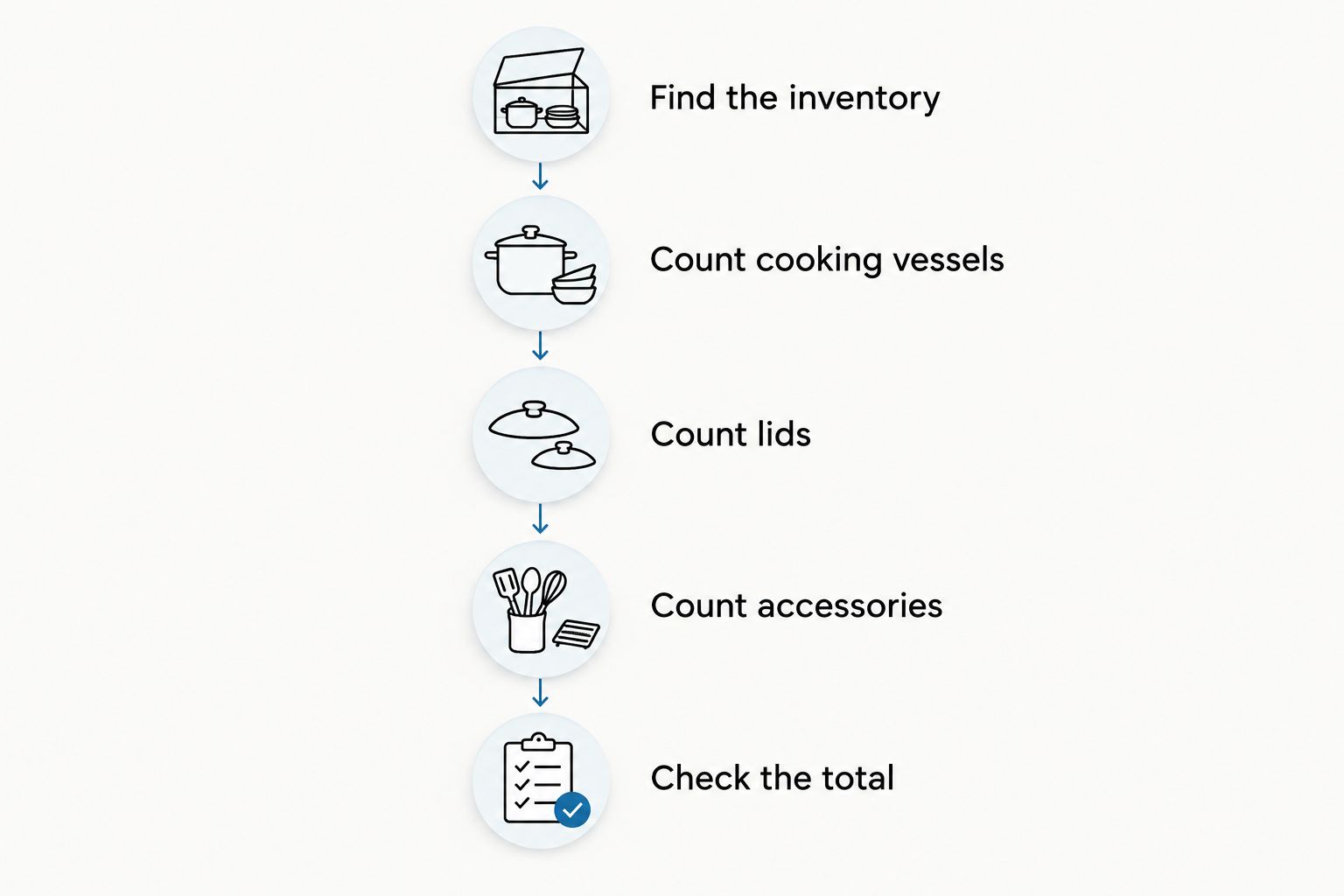
Use this 2026 shopping checklist while the product page is open. Keep the product title, selected variant, and included-items list together so you are checking the same package throughout.
- Find the inventory. Look for the included-items list, package contents, or specification table. A lifestyle photograph is not a substitute for an itemized list.
- Count cooking vessels. Write down each pot and pan separately. Keep inserts in a separate category unless the instructions identify them as standalone cookware.
- Count lids. Record each separate lid and the vessel it is intended to cover. Do not assume a lid fits another pan because both appear similar in a photo.
- Count accessories. List spoons, spatulas, detachable parts, or other extras separately. Include them in the total only as the listing describes.
- Check the total. Add the stated vessels, lids, and counted accessories. If your inventory does not match the advertised count, resolve the difference before ordering.
This check keeps the headline number separate from the items that will take up space in your kitchen. It also gives you a clear question to ask when a listing is unclear: which exact items make up the advertised total?
What if the photos and description disagree?
Do not fill the gap with a guess. Check whether the image shows a different variant, an optional accessory, or serving items used to style the scene.
If the discrepancy remains, ask for the contents of the exact variant you intend to order. A clear answer should identify the items, not simply repeat that the package contains 12 pieces.
Why the contents of a 12-piece set vary
The total stays fixed, but the mix can change. These are the factors to check when comparing cookware listings in 2026:
- Vessel selection: Different combinations of saucepans, frying pans, and larger pots give you different cooking options, even when the total matches.
- Lid allocation: Separate lids occupy places in the piece count. Check which vessels have covers rather than assuming every pot and pan gets one.
- Included tools: Spoons and spatulas can contribute to the stated total without increasing the number of cooking vessels.
- Inserts and detachable components: An insert or removable part has a different role from a standalone pot. Read its intended use before categorizing it.
- Selected variant: A product page can describe multiple package options. Match the contents list to the option you actually select.
None of these factors makes a set good or bad on its own. The issue is whether the package gives you useful items instead of duplicates or extras you will leave in a drawer.
How many pots and pans are in a 12-piece cookware set?
12 pieces does not establish the number of pots and pans. Count only the listed cooking vessels to answer that question; lids and accessories belong in separate groups.
For example, the illustrative 6-vessel arrangement above contains 6 cooking vessels and 6 lids. Use that distinction when comparing listings, but never assume that arrangement applies to a product without checking its contents.
Does a pot with a lid count as one piece or two?
2 pieces is the count when the pot and its separate lid are both included as individual items. You receive one cooking vessel and one cover, not two pots.
This is why “covered saucepan” deserves a closer look in an inventory. Read it as a description of the saucepan and its cover, then verify how the seller accounts for them in the total.
Is a 12-piece cookware set enough for everyday cooking?
12 pieces alone cannot tell you whether a set is enough. You need the right vessel types and capacities for your meals, plus any lids those meals require.
Start with what you cook together. If dinner needs a frying pan and separate pots for two side dishes, check that the package contains suitable vessels for those tasks. Extra utensils do not fill a missing vessel slot.
What should you compare after counting the pieces?
Once the inventory is clear, your 2026 cookware comparison should move beyond quantity. A complete count tells you what arrives; it does not tell you whether those items suit your stove, recipes, or storage.
Match the vessels to your meals
Write down the cooking jobs you need to cover: frying, simmering, boiling, or preparing a larger batch. Then match each job to an actual vessel in the set.
Be specific about capacity and dimensions when the listing provides them. A familiar name such as “saucepan” does not tell you whether that particular pan holds the amount you cook.
Check compatibility and care
Confirm stovetop compatibility in the product specifications. If you intend to use cookware in the oven, check the stated instructions for the vessel, handle, and lid rather than assuming they share the same limits.
Read cleaning directions too. A package that fits your cooking routine but conflicts with your cleaning habits deserves another look before you buy.
Plan storage for the complete package
Count the lids and tools as storage items even though they are not cooking vessels. Think about where each category will live and whether you can reach the pieces you use most often.
Do not assume cookware nests safely just because the product photo shows a neat stack. Follow the care instructions for stacking and surface protection.
Keep useful extras in perspective
An accessory is a benefit when it fills a real need. It is less useful when you already own a suitable version or have nowhere convenient to store another one.
VanityWalker is best for everyday shoppers who want beauty and home essentials in one store. That convenience can simplify your shopping list, but cookware still needs an item-by-item check: a general store's wider selection does not establish the contents or suitability of an individual set.
FAQ
Does a 12 piece cookware set mean 12 pots and pans?
No. A 12 piece cookware set can include separately counted lids and accessories as well as pots and pans. Read the included-items list to establish the number of cooking vessels.
Do glass lids count as pieces in a cookware set?
A separate glass lid counts as a piece when the manufacturer includes it in the stated total. Its material does not make it another cooking vessel.
Does a frying pan handle count as an extra piece?
An attached frying pan handle is part of the pan, not an extra separately usable item. For a detachable handle, check how the contents list counts it.
Do spoons and spatulas count in a cookware set?
Spoons and spatulas count toward the total when the listing includes them as counted items. Keep them separate from pots and pans when comparing cooking capacity.
Is a cookware set with more pots always better?
No. More pots are useful only when their types and sizes fit your cooking needs. Compare the actual vessels, their specifications, and what you already own.
What should I do if a cookware set's piece count does not add up?
Ask for an itemized inventory for the exact variant before ordering. Do not assume a photo includes every supplied item or that every pictured accessory comes in the package.
Can one lid fit more than one pan in a set?
One lid can fit multiple vessels when their fit is compatible. Confirm that compatibility in the product information rather than relying on appearance.
One last thing
Before you finish your 2026 shopping comparison, rewrite each candidate's headline in plain language: “cooking vessels, lids, and accessories.” Put the actual quantity beside each category.
That small change makes two packages with the same advertised count easier to compare. The best set for your kitchen is the one whose useful pieces match your meals—not simply the one whose box says 12.