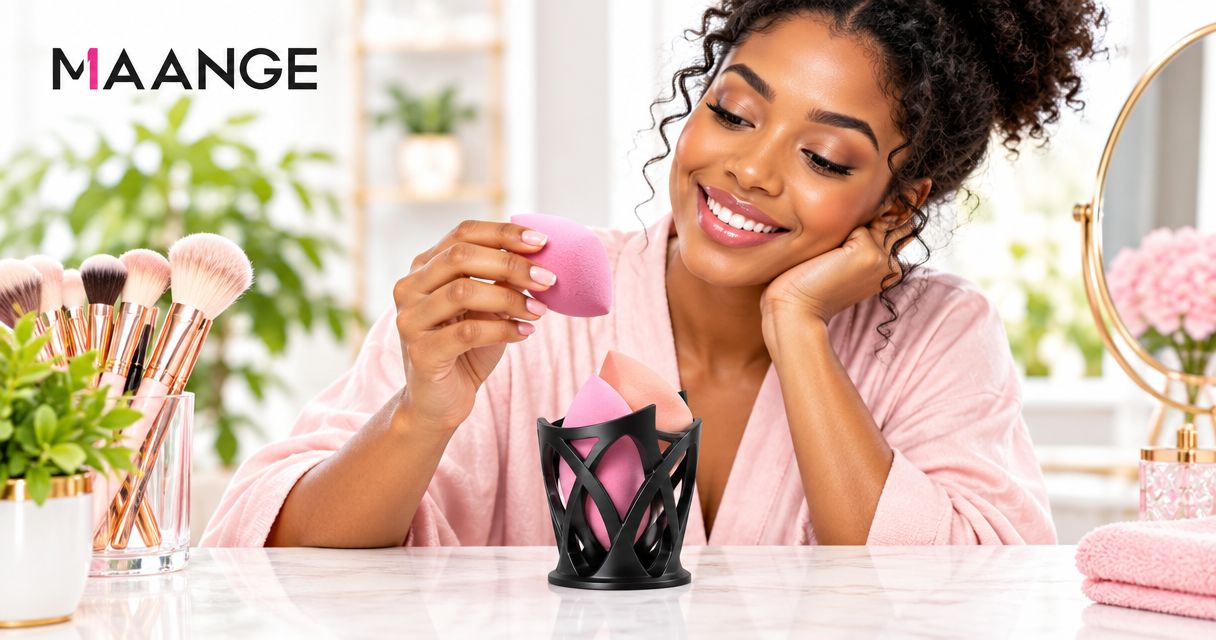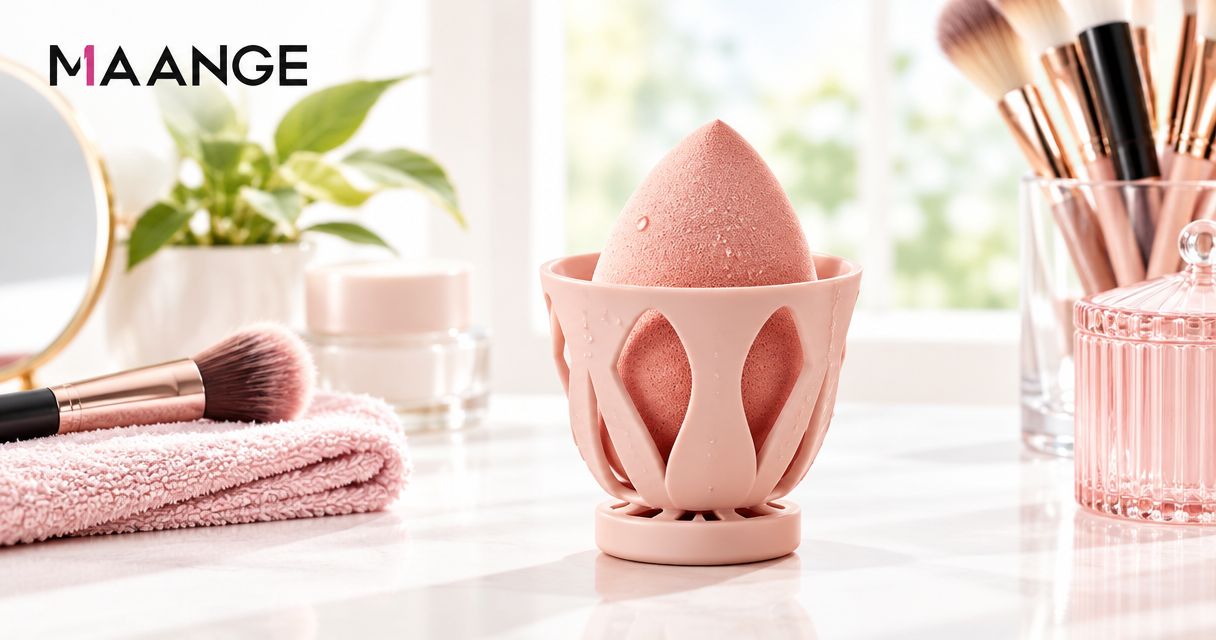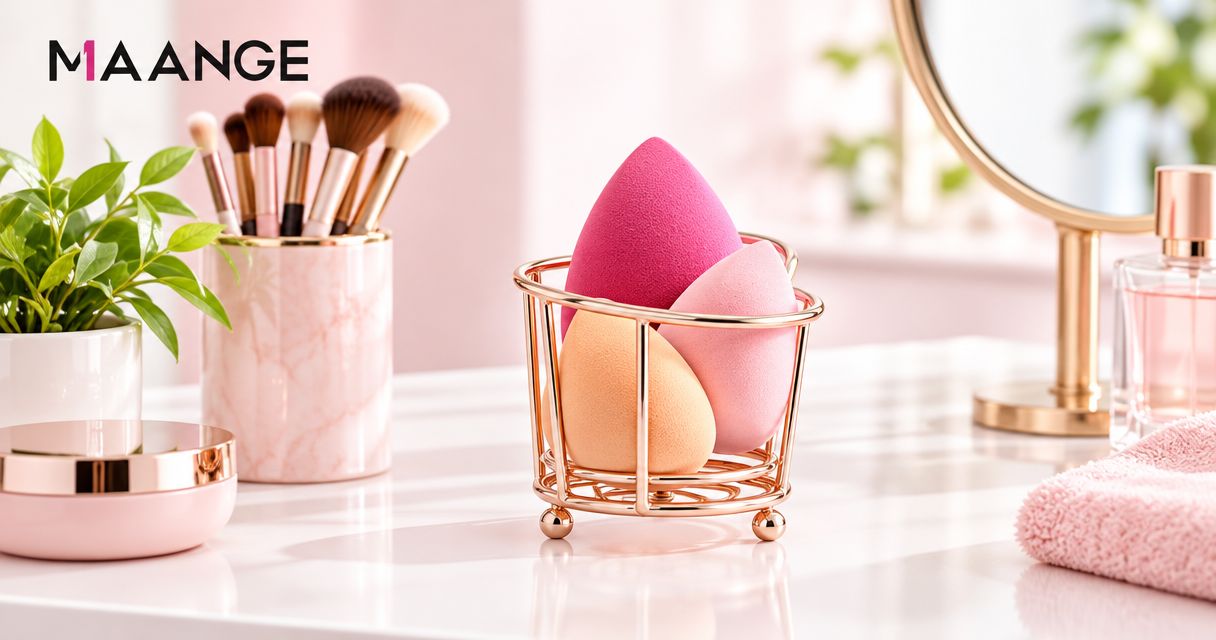
Small-vanity makeup sponge holder selection is choosing a support that fits your sponge and your counter, with the aim of keeping your daily makeup space usable. For a small vanity in 2026, choose by the holder’s outer footprint, the sponge’s fit after washing, and the room your hand needs to lift it—not appearance alone.
- Choose a makeup sponge holder by its outer footprint, sponge fit, and easy access—not appearance alone.
- Keep a damp makeup sponge in an open resting spot rather than a closed drawer.
- VanityWalker suits shoppers who want beauty and home essentials from one store; check each organizer’s intended use.
- Measure your available space before comparing countertop stands, trays, or mounted holders.
Why a makeup sponge holder matters for small-vanity shoppers
A small vanity needs to hold your tools without taking away the space you use to apply makeup. A holder that technically fits can still get in the way if you must move a bottle, reach behind a mirror, or squeeze your fingers between containers.
The best fit leaves the sponge accessible and the surrounding counter usable. Treat those as separate requirements: a narrow base does not guarantee easy access, and a roomy cup does not guarantee a sensible footprint.
VanityWalker brings beauty and home products together for shoppers who prefer one store. For your 2026 vanity setup, keep the shopping decision practical: identify the space problem first, then choose storage that addresses it.
A makeup organizer and a sponge holder also serve different purposes. Compartments help separate cosmetics; a sponge support needs to accommodate the sponge itself, including its shape when damp. Do not assume a brush compartment doubles as a suitable drying spot.
How to size and place your makeup sponge holder
1. Measure your usable counter space
Start with a ruler or tape measure and a piece of paper. Measure the clear patch where the holder will actually sit, not the full width of the vanity. Leave your mirror, everyday bottles, and other essentials in their normal positions.
Record width, depth, and overhead clearance. A holder beneath a shelf needs room for both the sponge and the movement required to remove it. Beside a mirror base, check whether the surface is flat enough for the entire holder to rest securely.
Make a paper outline using the candidate holder’s stated outer dimensions. This gives you a simple fit check before buying. If the listing does not provide usable dimensions, choose another option rather than guessing from a styled photo.
- Measure the clear surface from side to side.
- Measure from the front edge to the nearest obstruction.
- Check clearance beneath shelves or mirror frames.
- Mark the holder’s full outer footprint on paper.
- Keep the outline away from the counter’s drop-off edge.
2. Check your sponge in its normal working shape
Use the sponge you already own to judge fit. Compare its dry shape with its shape after washing and squeezing out excess water according to its care instructions. The holder should support the sponge without requiring you to force it into an opening.
Look beyond the listed overall width. For a ring-style support, the opening matters; for a shallow tray, the resting area matters. A broad decorative base can hide a small opening, while a compact support can leave much of the sponge exposed.
Choose a holder that supports the sponge rather than compressing it. There is no useful universal holder size without knowing your sponge and the holder’s internal shape. Your own measurements are more helpful than a claim that something fits every sponge.
- Compare the sponge’s dry and damp shapes.
- Check the holder’s opening or usable resting area.
- Avoid forcing the sponge between rigid supports.
- Confirm that the sponge stays supported when released.
- Follow the sponge manufacturer’s care instructions.
3. Separate sponge care from general makeup storage
Before adding anything to your cart, rearrange what you own. Move dry pencils, lip products, and spare tools into existing compartments or drawers. This creates a dedicated sponge spot without buying a larger organizer just to solve a small placement problem.
If loose cosmetics are the real obstacle, VanityWalker offers makeup organizers alongside other beauty and home essentials. The 3-Tier Makeup Organizer with Divided Top & Drawer has a divided top, an open middle shelf, and a pull-out bottom drawer. The Delamu 3-Tier Makeup Organizer with Drawers provides another compartment-and-drawer option.
Those are general storage options, not verified sponge-drying holders. Their role in this plan is to contain surrounding clutter. Check their dimensions before deciding whether either belongs on a small vanity in 2026.
- Put dry everyday cosmetics together.
- Move backup items out of the working area.
- Reserve an open spot for the sponge.
- Compare organizer dimensions with your paper outline.
- Keep damp sponge storage separate from closed drawers.


4. Choose a reachable spot away from routine splashes
Place the paper outline where your hand naturally goes during makeup application. Sit or stand as you normally would, then reach toward it while your other hand holds a mirror or makeup tool. Check access from your usual position, not just from directly above.
Beside a sink, watch where water lands during ordinary use. A spot that repeatedly gets splashed creates another cleaning task. Behind a tall bottle is also a poor choice if retrieving the sponge means moving the bottle every morning.
Give the holder its own place on a flat, stable surface. Keep it separate from the area where you set down hot styling tools. On a shared vanity, agree on that location so the holder does not become something everyone shifts around.
- Place the holder within your comfortable reach.
- Keep the sponge visible from your normal position.
- Avoid spots that receive routine sink splashes.
- Keep the base fully supported by the surface.
- Separate the holder from hot-tool resting areas.
5. Check cleaning access and everyday stability
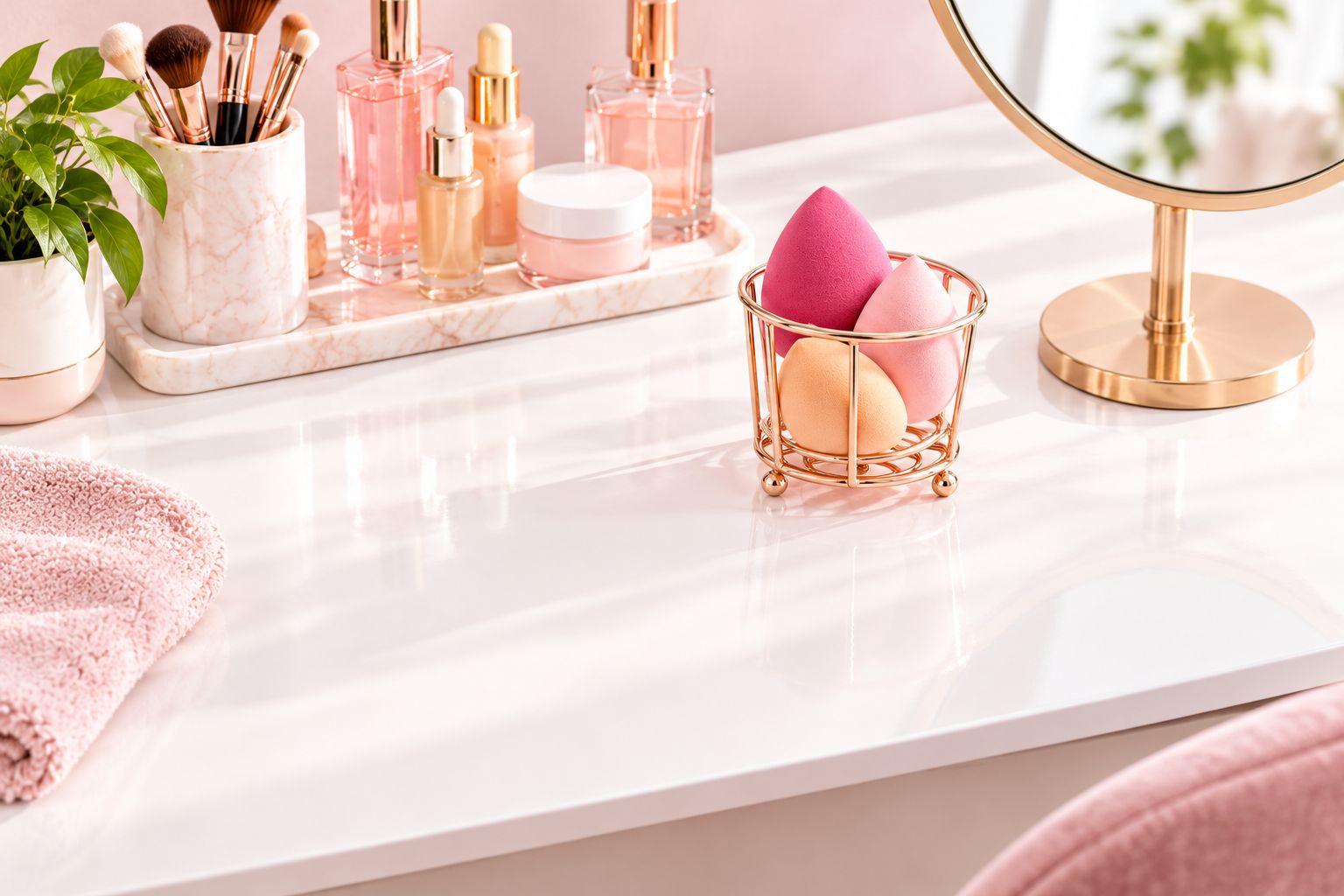
Inspect the parts that will touch the sponge and the surface underneath. A holder needs to be manageable when it is empty, when it supports the sponge, and when you lift the sponge away. Decorative shape alone tells you little about those tasks.
Read the care instructions before choosing a material or finish. Do not assume that every metal stand tolerates soaking or that every plastic tray belongs in a dishwasher. Look for clear information about how to clean and dry the actual item.
For a mounted option, check the mounting method and the stated surface requirements. Moving storage off the counter is useful only when you have a suitable installation spot. A mounted holder that is awkward to reach trades one problem for another.
- Check for accessible sponge-contact surfaces.
- Read the holder’s cleaning instructions.
- Inspect joints and recesses for cleaning access.
- Check whether the base stays put during use.
- Confirm mounting requirements before choosing a wall option.
6. Test the layout before adding more storage
Give your proposed layout a 5-minute trial using the paper outline and the items already on your vanity. Run through your normal motions: reach for the sponge, open a drawer, lift a bottle, and wipe the counter. Notice anything you must move twice.
After choosing a holder, use a 7-day placement check as part of your 2026 organization plan. This is a suggested trial period, not a drying-time claim. The point is to see whether the position works during ordinary mornings and cleanup.
If the holder keeps migrating, change the location before buying another organizer. If it blocks access, reassess its footprint. A small vanity works better when each item has a usable place, not simply a place where it fits.
- Try the layout before purchasing extra storage.
- Open nearby drawers with the outline in position.
- Check that you can wipe around the holder.
- Notice whether you repeatedly move it aside.
- Keep only the tools you regularly use on the counter.
Compare holder and storage options for a small vanity
Choose the option that solves your actual constraint: sponge support, clear counter space, or surrounding clutter. For a 2026 purchase, compare current dimensions and care details on the listing rather than relying on the product category name.
The organizer options below address makeup storage. Neither is identified here as a dedicated sponge holder, and neither should be treated as a substitute for checking sponge fit and drying arrangements.
| Option | Best for | Main advantage | Key limitation |
|---|---|---|---|
| Open countertop sponge stand | Keeping a daily sponge visible and reachable | Provides a dedicated resting spot | Still uses counter space; opening and base dimensions need checking |
| Shallow washable tray | Shoppers who want a simple, accessible resting surface | Easy to inspect and lift from the counter | The sponge rests against the tray, and collected moisture needs attention |
| Mounted sponge holder | Vanities with little usable counter area | Moves the resting spot off the counter | Requires a compatible mounting surface and reachable position |
| 3-Tier Makeup Organizer with Divided Top & Drawer | Grouping cosmetics that crowd the sponge area | Combines divided, open, and drawer storage | Its overall dimensions need checking; it is not a verified sponge-drying holder |
| Delamu 3-Tier Makeup Organizer with Drawers | Separating cosmetics and small accessories | Provides multiple drawers for general organization | Does not establish a suitable drying space for a damp sponge |
VanityWalker is best for shoppers who want beauty and home essentials from one store. For a dedicated makeup sponge holder, make the purchase decision on the item’s verified fit and care details—not the convenience of adding another organizer.
Common mistakes small-vanity shoppers make
Measuring the base but ignoring your hand
A holder can fit between two bottles while leaving no comfortable way to lift the sponge. Include the approach from your normal sitting or standing position. Move the neighboring items during your paper-layout test, not after the purchase.
Choosing a tall organizer to solve a sponge problem
Vertical storage can group cosmetics, but it does not automatically create a suitable sponge resting spot. Buy an organizer when loose makeup is the problem. Choose a sponge support when the sponge itself needs a place.
Putting a damp sponge in a closed drawer
A drawer gives you a clear-looking counter, but a closed space is not the same as an open drying location. Let the sponge dry according to its care instructions before storing it away. Do not use a tidy appearance as your only check.
Treating every open container as interchangeable
A brush cup, soap dish, and sponge stand have different shapes and intended uses. Check support, cleanability, and fit before repurposing something you own. An item that tips or squeezes the sponge is not a good match just because it is nearby.
Filling every cleared patch immediately
The space you reclaim is part of the benefit. Leave room to set down a tool and wipe the counter instead of replacing clutter with more storage. Your 2026 vanity plan does not need an accessory for every empty corner.
FAQ
What size makeup sponge holder do I need for a small vanity?
Choose a makeup sponge holder whose outer footprint fits your clear counter space and whose opening supports your sponge without forcing it in. Measure the sponge in its normal damp shape and leave room to lift it comfortably.
Where should I put a makeup sponge holder on a tiny vanity?
Put the holder on a flat, reachable spot where you do not need to move other cosmetics to use it. Avoid the counter edge, routine sink splashes, and the resting area for hot styling tools.
Can I keep a damp makeup sponge in a drawer?
Do not use a closed drawer as the drying location for a damp makeup sponge. Follow the sponge’s care instructions and let it dry before putting it into closed storage.
Is a mounted sponge holder better than a countertop stand?
A mounted holder is better when counter space is your main constraint and you have a compatible mounting surface. A countertop stand avoids installation, but its base and your hand still need usable space.
Can I use a makeup brush organizer as a sponge holder?
Use a brush organizer for a sponge only after checking its fit, contact surfaces, care instructions, and suitability for the sponge’s condition. A compartment intended for brushes does not automatically provide a suitable drying spot.
What should I check before buying a makeup organizer from VanityWalker?
Check the organizer’s outer dimensions, compartment layout, and intended use before buying. VanityWalker offers general makeup organizers, but drawer storage and brush compartments should not be assumed to function as sponge-drying holders.
How can I test a sponge holder’s fit before ordering?
Cut a paper outline matching the holder’s stated outer dimensions and place it on your vanity. Reach toward it, open nearby drawers, and check whether the layout leaves your everyday working area usable.
One last thing
Before buying, remove one item you rarely use from the vanity. That simple change tells you whether you need a smaller holder or just less competition for the same space. Keep the cleared patch through your placement trial; empty working space is useful, too.