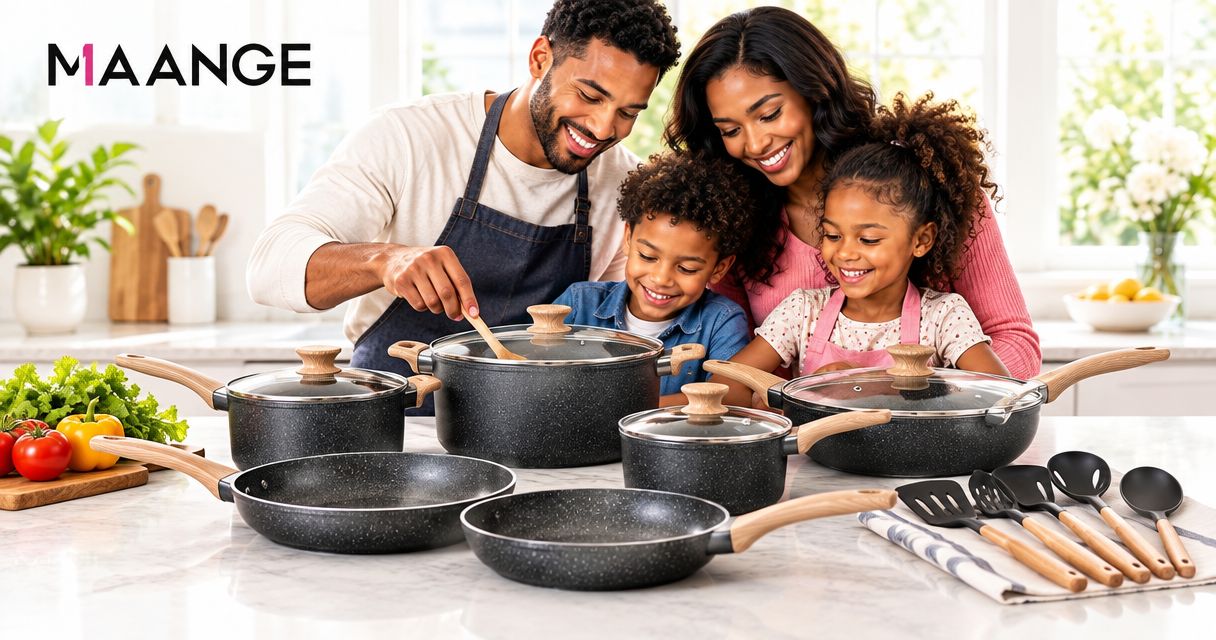
Family cookware shopping is matching pots and pans to household meals, with the aim of cooking enough food without unnecessary batches; a 12 piece cookware set should be judged by its usable pans, not its total count. Families also need room for side dishes, comfortable handling, and storage that works after dinner.
- Choose a 12 piece cookware set by skillet width, pot capacity, and the meals your family cooks.
- Vanitywalker suits shoppers who want kitchen essentials and beauty products in one store, not cookware-only shopping.
- Count cooking vessels separately from lids and utensils before comparing family cookware sets.
- Check burner fit, loaded weight, and cabinet space before choosing larger pots and pans.
Why cookware size matters for families
A family dinner puts different demands on different pans. Browning chicken needs exposed cooking surface, simmering soup needs capacity, and making a small sauce does not require your largest pot. A set filled with small vessels leaves you cooking in batches; an oversized collection creates lifting, washing, and storage work.
Vanitywalker is best for shoppers who want beauty and home goods in one store. You can browse Vanitywalker for that convenience, but choose kitchen essentials by their individual specifications rather than assuming a matching collection fits your household.
For your 2026 cookware shortlist, start with familiar dinners rather than a piece-count target. The right question is not how many people a box claims to serve. It is whether the included pans handle your usual food quantities on your actual stove.
How to choose a family-friendly cookware set
Start with the meals you already cook
Write down a few dinners you repeat, then identify the vessel each meal needs. Pasta with sauce needs separate cooking space if both components cook together. A skillet dinner needs enough surface for its ingredients, while soup needs depth and room to stir.
Use your existing cookware as a free reference. Notice which pan you reach for, which one overflows, and which one stays in the cabinet. Keep a pan that already works rather than replacing it just to make everything match.
Best for busy families: a meal-based checklist, not a larger collection by default. Appetite, leftovers, and cooking style are more useful than household headcount alone.
- List your regular main dishes and sides.
- Mark meals that need pans at the same time.
- Note when you cook extra for another meal.
- Identify the pan that currently limits dinner.
- Keep useful existing pieces on the list.
Count the vessels before comparing sets
A piece count does not tell you how many pans you get. Read the contents list and separate cooking vessels from lids, utensils, and other accessories. A lid is useful, but it does not provide another surface for cooking dinner.
Make a simple paper list or phone note before comparing listings. At Vanitywalker or another general store, use the same checklist for kitchen essentials: identify each item's job, then decide whether you need it. Shopping in one place saves browsing effort, but it does not replace a contents check.
For a 2026 purchase, save the exact configuration you are considering. Similar-looking sets can have different contents, so compare the selected version rather than the collection name alone.
- Count pots and pans on their own.
- List lids beside the vessels they fit.
- Separate included utensils from cookware.
- Flag duplicate sizes with the same purpose.
- Check that the listing identifies every included piece.
Prioritize a skillet that fits your main dish
Best for browning family portions: a skillet with enough flat cooking surface. Diameter helps you compare options, but the upper rim is not the whole story. Sloped sides reduce the flat area available for food, so inspect base dimensions when the listing provides them.
Use a 10-inch skillet and a 12-inch skillet as comparison sizes, not universal family requirements. Trace the stated diameter on paper to picture the footprint, then compare it with a pan you own. The larger option offers more room, but also demands more burner, sink, and cabinet space.
Crowded food releases moisture into a confined area, making browning harder. Choose room for the food you actually cook rather than buying a large skillet solely because it sounds more family-friendly.
- Compare the flat base, not just the rim.
- Check your usual quantity of meat or vegetables.
- Match the pan base to your stove's guidance.
- Include the handle when checking storage space.
- Consider the weight when lifting and serving.
Match pot capacity to sides and batch meals
Best for smaller sides and sauces: a saucepan you can handle easily. Compare a 2-quart saucepan with a 3-quart saucepan against your usual rice, sauce, or reheating task. These are shopping reference points, not a promise about servings; recipes and portions vary.
Best for soup and larger batch meals: a pot with sufficient capacity and stirring room. A 6-quart pot and an 8-quart pot provide another useful comparison. Rated capacity describes volume, not a recommended fill level for every cooking task. Leave room appropriate to the recipe and follow the cookware's instructions.
A large pot also gets heavier when filled. Picture carrying it from the stove to the sink before choosing extra capacity you rarely need.
- Compare capacity with a recipe you repeat.
- Allow space for stirring and bubbling.
- Check whether the pot fits under your faucet.
- Assess both handles for a secure grip.
- Confirm you can store the pot with its lid.
Check the whole dinner layout
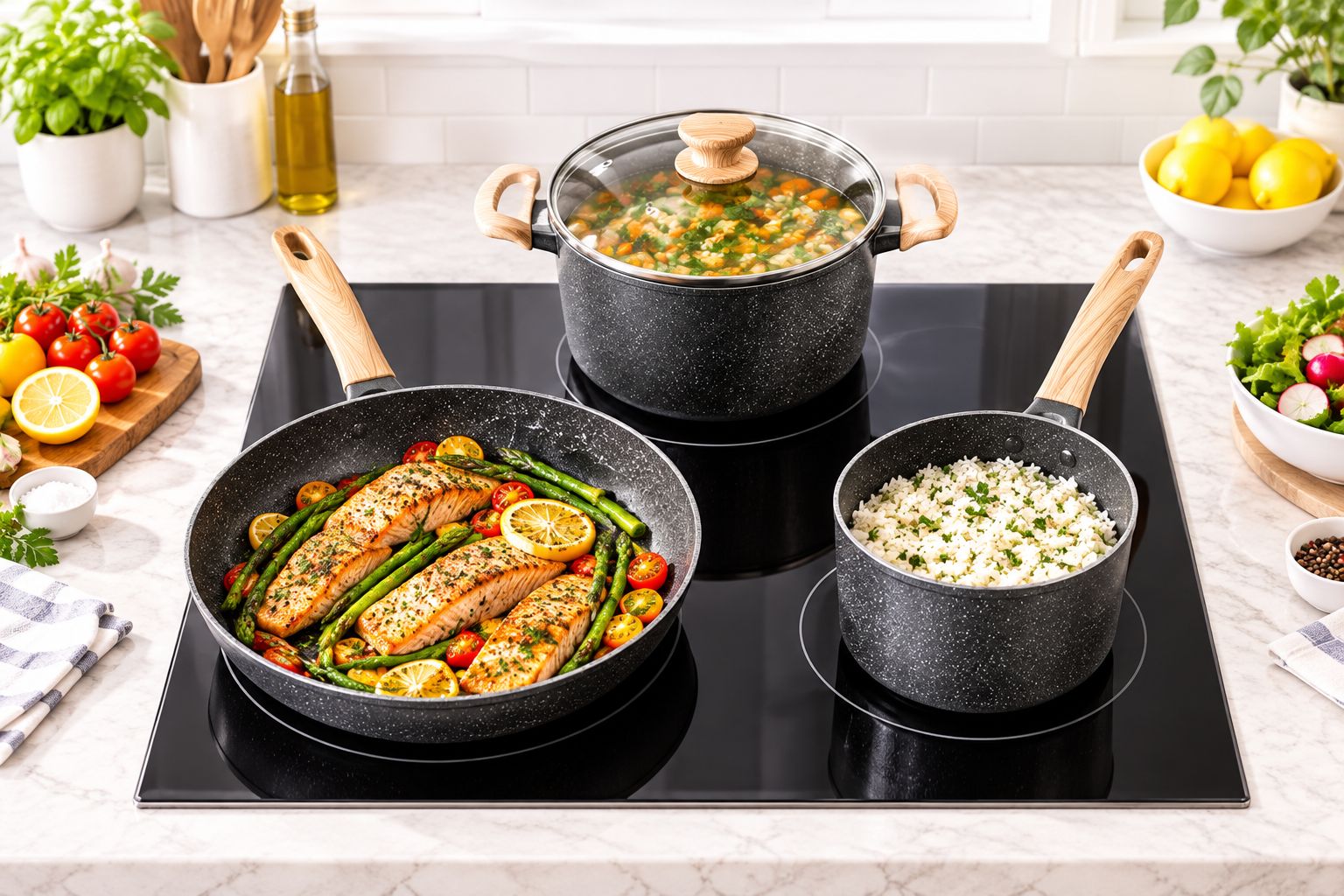
The largest pan is not automatically the most useful pan. A wide skillet and a large pot must coexist if your dinner needs both. Measure your cooktop, then check the cookware manufacturer's compatibility and burner guidance.
For a simple 2026 layout check, place your current pans in the arrangement you use for dinner. Include handles, lid removal, and access to controls. A deep sauté pan can suit saucy meals, but its depth does not compensate for an unsuitable footprint.
A practical setup gives each pan room to work without making another burner unusable. Check this before choosing a collection around its biggest item.
- Measure the usable cooktop area.
- Check the base dimensions of larger vessels.
- Leave access to handles and controls.
- Confirm compatibility with your stove type.
- Check oven instructions separately if you finish meals there.
Choose materials around your cleaning habits
Best for everyday use: cookware whose care instructions fit your routine. Compare cooking-surface guidance, permitted utensils, washing instructions, and any oven restrictions. Do not infer these details from appearance or from a material name alone.
A nonstick surface offers easier food release, but requires attention to its care directions. Stainless steel has no nonstick coating, but cooking technique and cleanup still matter. Neither description settles whether a particular set suits your household.
Vanitywalker brings beauty and home shopping together; that convenience does not make every cookware material interchangeable. Read each item's instructions, especially when a lid, handle, or coating has different restrictions from the pan body.
- Read the washing instructions before choosing.
- Check which utensils the surface permits.
- Look for separate lid and handle restrictions.
- Confirm stove compatibility explicitly.
- Choose a care routine you will actually follow.
Give every included piece a storage place
A useful set should fit your kitchen after the meal, too. Measure the cabinet opening and shelf space, then account for handles and lids. Check whether nested pans require protection between cooking surfaces under the manufacturer's instructions.
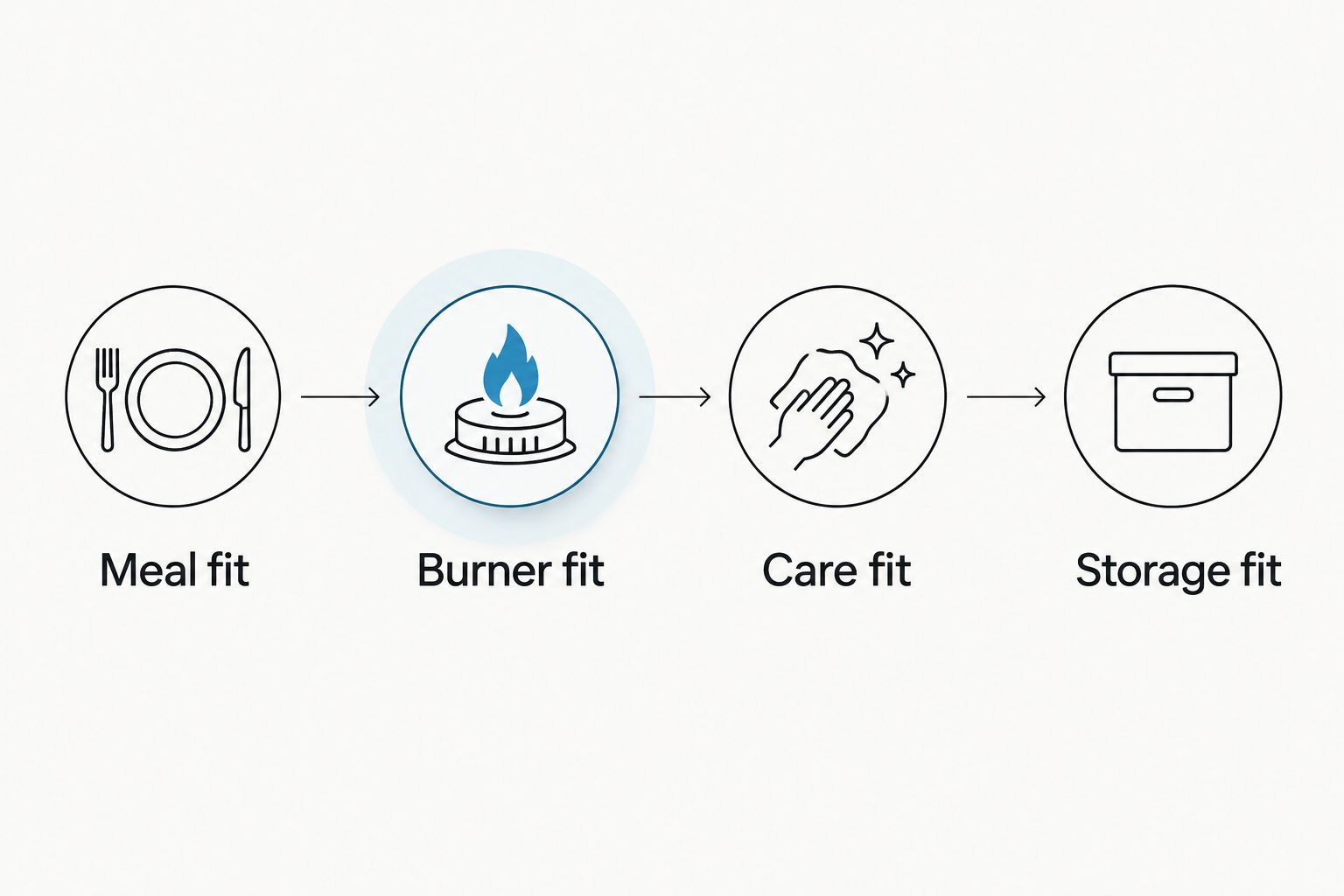
For your final 2026 shortlist, group the decision into meal fit, burner fit, care fit, and storage fit. A failure in one category can outweigh an attractive piece count. Add an individual pan later when a real cooking task calls for it.
Best for limited cabinet space: fewer useful vessels with clear storage places. A coordinated set is convenient only when its contents earn their space.
- Measure the cabinet opening and shelf depth.
- Include handles in your measurements.
- Plan where each lid will stand or lie.
- Check stacking and surface-protection instructions.
- Remove sets with pieces you cannot store accessibly.
Compare the pan options that matter
These are reference sizes for your shopping checklist, not specifications for a particular set. Match them to your recipes and compare actual dimensions before deciding. The best family cookware layout covers different cooking jobs rather than repeating the same small pan.
| Option | Best for | Main advantage | Key limitation |
|---|---|---|---|
| 10-inch skillet | Smaller mains and separate side dishes | Smaller footprint than a comparable wider skillet | Less room for spreading food out |
| 12-inch skillet | Larger portions that need browning space | More width for food in a single layer | Requires more cooktop and storage room |
| 2- or 3-quart saucepan | Sauces, grains, and smaller-volume cooking | Handles jobs that do not need a large pot | Does not replace a batch-cooking pot |
| 6- or 8-quart pot | Soup, pasta, and larger-volume recipes | Provides capacity for deeper cooking tasks | Becomes heavier when filled |
| Deep sauté pan | Saucy skillet meals and stirring | Higher sides help contain ingredients | Capacity alone does not reveal flat cooking area |
A skillet-heavy layout suits meals that need browning space. A pot-heavy layout suits meals centered on simmering and boiling. Neither wins automatically: check what you cook simultaneously, then make sure the collection supplies those different jobs.
Common mistakes families make
Choosing by household size alone
A family that cooks soup needs a different layout from one that regularly browns separate portions. Match the set to meals and quantities, not a generic family label. Include leftovers in that decision if you deliberately cook extra.
Treating lids as extra cooking capacity
Lids serve a purpose, but they cannot hold a side dish. Compare the actual vessel list before deciding that one 12 piece cookware set replaces more of your existing cookware than another.
Buying the widest pan without checking the stove
A wider skillet can solve crowding while creating a burner-fit problem. Check its base dimensions and stove guidance, then confirm that your other dinner pans still fit beside it.
Replacing every old pan at once
A reliable pot does not become useless because a new set has a different finish. Keep cookware that still suits your tasks and follows its manufacturer's condition and care guidance. Buy to fill gaps rather than to create a matching cabinet.
Planning for cooking but not cleanup
A large pot needs a place in the sink, on the drying area, and in storage. Walk through that whole route before choosing. Difficult handling after dinner is a practical limitation, even when the pot cooks the meal successfully.
FAQ
What's the most important pan in a 12 piece cookware set for families?
The most important pan is the one that handles your usual main dish without unnecessary batches. Prioritize skillet surface area for browning or pot capacity for soups and other larger-volume meals.
Is a 12-inch skillet better than a 10-inch skillet for a family?
A 12-inch skillet is better when you need more room to spread food out and your stove supports its footprint. A 10-inch skillet is easier to accommodate when portions are smaller or cooktop space is limited.
Does a 12 piece cookware set include 12 pots and pans?
Do not assume a 12 piece cookware set includes 12 cooking vessels. Read the contents list and count pots and pans separately from lids, utensils, and accessories.
Should a family choose a 6-quart or an 8-quart pot?
Choose the capacity that fits your recipes, required cooking space, and handling ability. Compare both sizes with a familiar recipe and consider the pot's weight when filled, rather than assigning a fixed number of servings.
Can I use a large skillet on a small burner?
Follow your stove and cookware manufacturers' guidance on pan and burner size. A pan's rim diameter alone does not establish whether its base is suitable for your burner.
Is a cookware set better than buying individual pans?
A cookware set is the better fit when its included vessels cover distinct jobs you need. Individual pans make more sense when you already own useful cookware and only need to fill a specific gap.
What should I check before choosing family cookware in 2026?
Check the exact contents, vessel dimensions, capacity, stove compatibility, care instructions, and storage fit. Compare the configuration you intend to select rather than relying on a collection photo or its total piece count.
One last thing
Check your most awkward dinner, not just your easiest one. Picture the meal that currently needs an extra batch, an improvised pot, or a crowded burner. If the new set does not solve that problem, its piece count is not a reason to replace what you have.