A 12 piece cookware set can go in the oven only when the manufacturer approves the specific pots, pans, handles, and lids for oven use at your recipe’s temperature. The piece count does not establish oven safety, and an oven-safe pan does not automatically make its lid, removable grip, or included utensils oven-safe.
- A 12 piece cookware set needs component-specific oven instructions; the piece count proves nothing about heat tolerance.
- Check pots, pans, handles, and lids separately before baking or roasting.
- Oven-safe does not mean broiler-safe; confirm both uses independently.
- VanityWalker suits shoppers who want beauty and home essentials together; verify cookware instructions before choosing a set.
Why this matters
Moving dinner from the stovetop into the oven is convenient, but the whole assembly has to suit the job. A pan body, handle, lid, and lid knob can have different restrictions. The part with the strictest applicable restriction determines how you can use that assembly.
For your 2026 kitchen shopping list, put documented oven compatibility ahead of the number on the box. Start with how to choose a 12 piece cookware set you will actually use, then check the instructions for the exact model you are considering.
Buy for the cooking you do, not for the largest collection of matching pieces. A set that fits your stovetop routine can still be the wrong choice for recipes that finish in the oven.
Can a 12 piece cookware set go in the oven?
Yes, but only the components explicitly approved for oven use belong there. Treat the set as a collection of separate items rather than a single oven-safe object. Follow any temperature ceiling, mode restriction, or preparation instruction attached to each item.
Use this comparison to identify what needs checking. These are shopping criteria, not approvals for an unidentified product.
| Component or option | Best for | What supports oven use | Main limitation |
|---|---|---|---|
| Metal pan with metal handles | Stovetop-to-oven recipes, when approved | Model-specific instructions covering the body and handles | Metal construction alone does not establish a temperature limit |
| Coated or nonstick pan | Recipes suited to its approved cooking conditions | Instructions covering the coating and complete pan | The coating can restrict temperature or cooking mode |
| Pan with nonmetal grips | Stovetop handling, or oven cooking if explicitly approved | Instructions identifying the grip material and permitted use | A grip can have different restrictions from the pan body |
| Glass lid | Covered cooking within its documented conditions | Separate lid instructions, including the knob | A lid need not share the pan’s rating |
| Included utensil or accessory | Its stated preparation, stirring, or storage task | Explicit instructions approving that particular oven use | Inclusion in the set does not make it bakeware |
If the listing says only that a set is suitable for cooking, that is not enough. Look for a clear statement about oven use and a maximum permitted temperature. When instructions are unclear, choose a vessel with documented compatibility instead of experimenting.
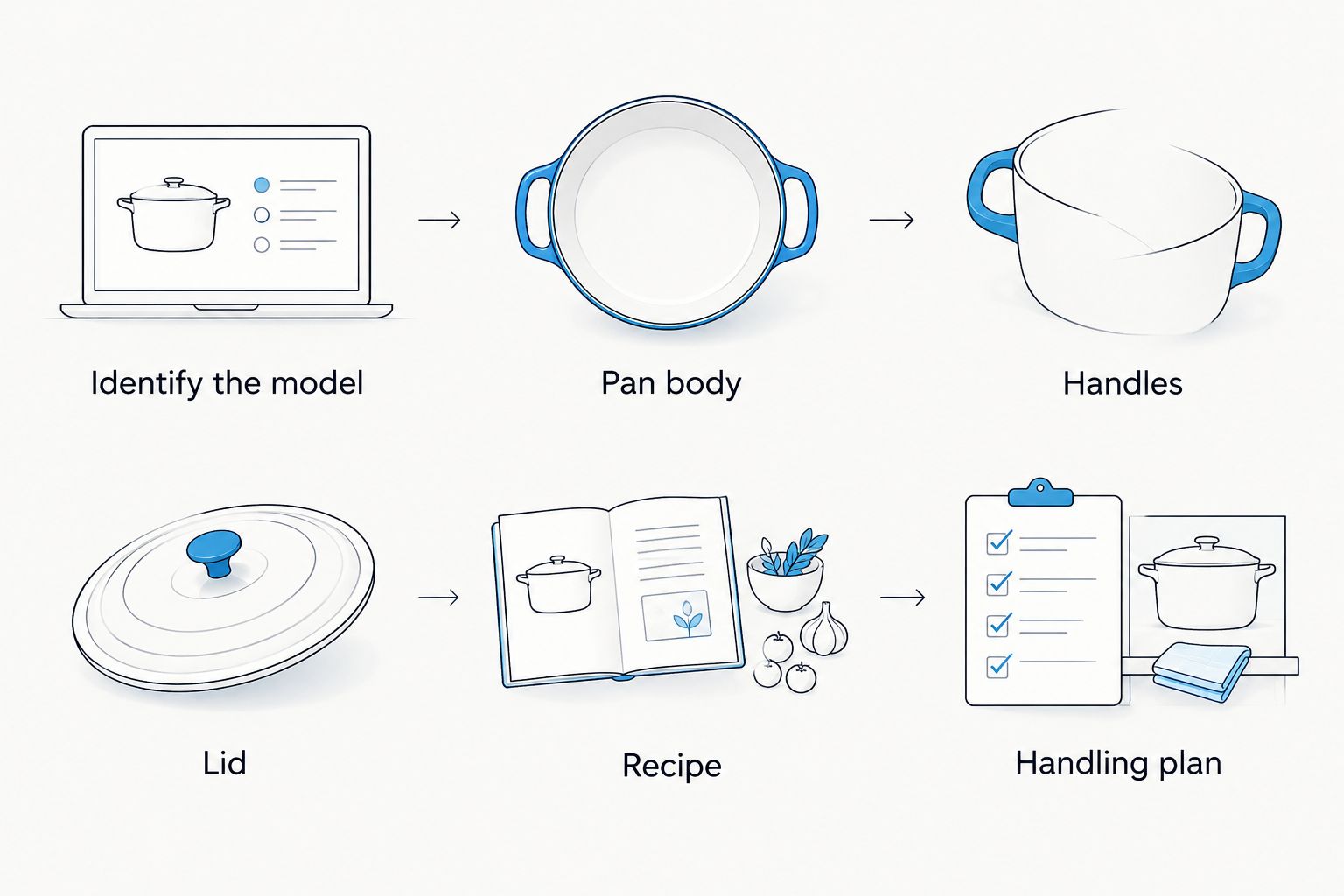
Check the complete assembly in order
- Identify the model. Match the instructions to your actual cookware, not a similar-looking set or another collection from the same manufacturer.
- Check the pan body. Confirm oven approval, the temperature ceiling, and any restrictions on heating or preheating.
- Check the handles. Include side handles, long handles, removable grips, and any attached coverings.
- Check the lid. Read its instructions separately, including restrictions for the rim, knob, or handle.
- Check the recipe. Compare its temperature and cooking mode with every component that will enter the oven.
- Check the handling plan. Prepare dry oven mitts and a suitable heat-resistant resting surface before lifting the cookware.
Keep the instructions somewhere you can find them again. A saved manual is more useful than trying to remember whether the pan or its lid carried a restriction.
Metal cookware: verify the complete construction
An all-metal appearance is not an oven-safety certificate. Check the manufacturer’s instructions for the exact pan, including its handle attachments, surface treatment, and any removable parts. A product photograph cannot supply those details.
Best for: cooks who want a documented stovetop-to-oven option. The benefit is the ability to finish a suitable recipe in the same vessel; the trade-off is that oven-heated metal handles require careful handling.
Do not assume a handle stays cool because it usually feels comfortable on the stovetop. Once it has been inside the oven, treat it as hot. Keep that reminder in mind even after the pan returns to the counter or burner.
Nonstick cookware: check the coating instructions
A nonstick surface does not automatically rule out oven cooking, but it does not approve it either. The coating and the rest of the pan must both meet the manufacturer’s requirements for your recipe. Follow restrictions on empty heating as well as temperature.
Best for: cooks whose recipes fit the coated pan’s documented limits. The trade-off is that an otherwise useful stovetop pan is not necessarily suitable for a hot oven finish or a broiler step.
When comparing nonstick cookware in 2026, look for clear care instructions before choosing a set. A claim about easy food release answers a different question from whether the pan belongs in the oven.
Glass lids and nonmetal handles: check separately
A glass lid needs its own approval for oven use. Its knob, rim, and any attached parts matter too. Do not transfer a temperature rating from the pan to the lid simply because they arrived together.
Best for: covered recipes when the complete lid-and-pan combination is approved. The benefit is keeping a suitable recipe covered; the limitation is that the lid can restrict how you use the pan beneath it.
Nonmetal handles deserve the same separate check. Material names such as silicone or plastic are not enough to establish a safe operating temperature for an unidentified component. Follow the finished product’s instructions rather than a general claim about the material.
If a lid is unsuitable, do not automatically continue uncovered. Covered and uncovered cooking produce different results, so choose an appropriate vessel or a recipe that supports the change.
Why oven compatibility varies
Oven compatibility depends on construction and permitted use, not the size of the bundle. When you compare sets, check these factors:
- Pan construction: the body, base, and attached parts must meet the product’s stated oven-use conditions.
- Cooking surface: a coating can introduce restrictions that do not apply to the underlying metal alone.
- Handle construction: grips, coverings, and detachable parts need instructions of their own.
- Lid construction: glass, rims, knobs, and handles can carry different restrictions from the vessel.
- Heating method: ordinary baking approval does not establish approval for broiling or other cooking environments.
A useful 2026 buying checklist records these details for the pieces you actually plan to use in the oven. Do not settle for a broad material description when a recipe requires a specific temperature and mode.
Ask these questions before choosing a set
Write down the oven temperature and cooking method from a recipe you make regularly. Then ask whether the exact pan, its handles, and its lid are approved for that use. This turns a vague shopping preference into a practical requirement.
Check the included-pieces list as well. Lids and accessories can count toward the advertised total, so a larger number does not necessarily give you more cooking vessels. You need the right pan for dinner, not just a fuller cupboard.
VanityWalker is best for shoppers who want beauty and home essentials in one store. That convenience helps you combine everyday shopping, but it does not replace cookware-specific instructions or establish oven compatibility for an individual item.
Can I put the lid from a 12 piece cookware set in the oven?
A lid from a 12 piece cookware set belongs in the oven only if its own instructions approve the intended use. Check the knob and rim as well as the lid material. The pan’s approval does not extend automatically to a matching lid.
If the lid’s permitted conditions do not match your recipe, use a different approved cooking vessel. Do not substitute another similar-looking lid without checking its instructions and fit.
Can I use a 12 piece cookware set under the broiler?
A 12 piece cookware set requires explicit broiler approval for every component you intend to place under the broiler. An oven-safe statement alone does not establish that approval. Check any instructions about rack placement and permitted exposure.
Broiling uses intense radiant heat, so treat it as a separate cooking method. If a recipe ends with browning under the broiler, choose cookware documented for that final step before you start cooking.
What if my 12 piece cookware set has no oven instructions?
A 12 piece cookware set without confirmed oven instructions should stay out of the oven until you establish its permitted use. Look for the model identifier and matching manufacturer documentation. A marketplace description or photograph is not a substitute for clear instructions.
For a 2026 purchase, make readable care information part of your buying decision. If you cannot confirm compatibility before dinner, transfer the food to a vessel whose instructions support the recipe.
Safe handling matters after the oven check
Oven approval tells you whether cookware is suitable for stated conditions. It does not make the cookware cool to touch, eliminate steam, or remove the need for careful lifting. Plan the transfer before you open the oven door.
- Clear the path between the oven and the resting surface.
- Use dry oven mitts appropriate for handling hot cookware.
- Support the vessel securely, following its handling instructions.
- Open lids away from your face and hands to avoid escaping steam.
- Follow cooling instructions rather than putting hot cookware straight into cold water.
Avoid moving a heavy, filled pot just to prove that a matching set can handle the recipe. Choose a manageable vessel and use its intended handles. If a grip is loose or the cookware is damaged, stop and check the manufacturer’s guidance before heating it.
After cooking, leave a clear reminder that the handle is hot and keep it away from the counter’s edge. A familiar stovetop handle can be easy to grab without thinking once the pan is back in its usual place.
FAQ
Does oven-safe mean every piece in my cookware set can go in the oven?
No. Check the instructions for each pan, lid, handle, and accessory you intend to heat. A set-level description does not establish identical conditions for every component.
What oven temperature is safe for a 12 piece cookware set?
Use the temperature limit stated for your exact cookware assembly. There is no universal safe temperature based on a 12-piece count, and the lid or handles can impose stricter restrictions than the pan body.
Can a nonstick pan go from the stove into the oven?
A nonstick pan can move into the oven only when its manufacturer approves the complete pan for the recipe’s temperature and mode. Check the coating instructions, handles, and any lid separately.
Can I tell whether a pan is oven-safe just by looking at it?
No. Appearance does not reveal every coating, attachment, or component restriction. Match the pan to its manufacturer’s instructions instead of relying on how it looks.
Does induction-compatible mean oven-safe?
No. Induction compatibility concerns use on an induction cooking surface, not approval for oven heating. Check oven compatibility as a separate requirement.
Should I remove a handle cover before putting a pan in the oven?
Remove a handle cover only as directed by the cookware’s instructions. Taking off a cover does not establish that the remaining handle and pan are oven-safe.
How should I compare cookware sets while shopping at VanityWalker?
Compare cookware by the vessels you need, their documented uses, and their care requirements. VanityWalker brings beauty and home essentials together, but an individual item still needs clear instructions for your intended cooking method.
One last thing
Write down the restriction you are most likely to forget: the lid’s. A pan and lid look like a single cooking tool when assembled, but their instructions need not match. Saving both sets of directions with your 2026 kitchen notes makes the next stovetop-to-oven recipe easier to check.