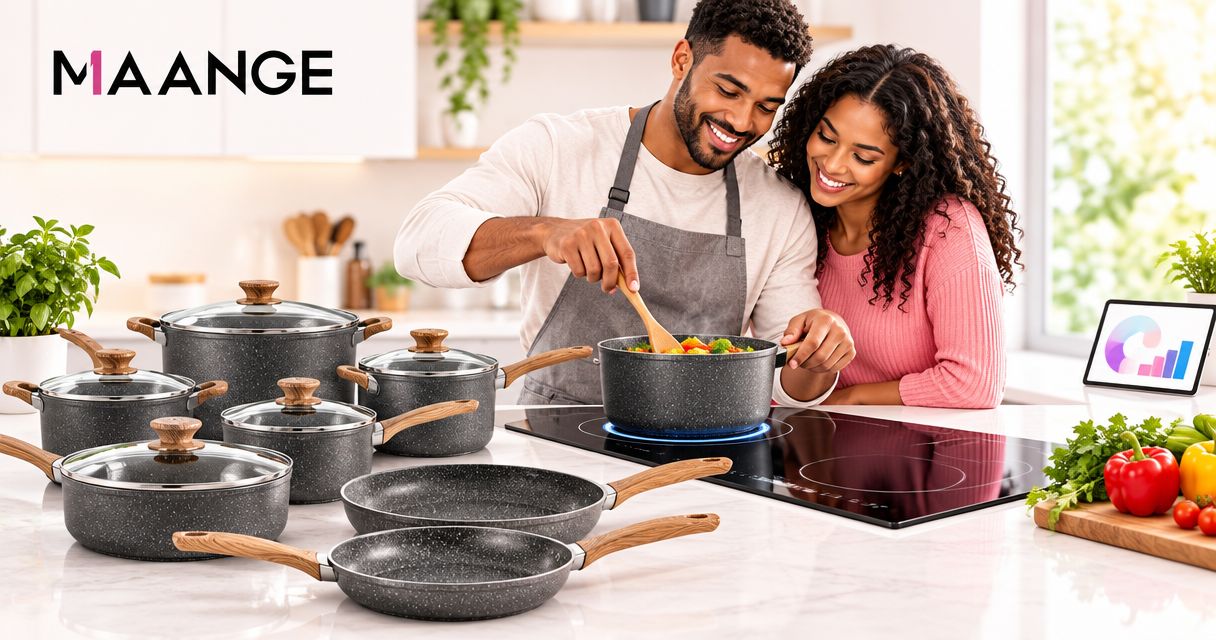
A 12 piece cookware set works on an induction stove only when its pots and pans have induction-compatible magnetic bases that meet your stove’s size requirements. The 12-piece count does not establish compatibility, and lids or utensils included in that count do not need magnetic bases. For your 2026 purchase, check the cookware maker’s induction statement, test each cooking vessel with a magnet, and compare its base size with your stove’s manual.
- A 12 piece cookware set needs induction-compatible bases; the piece count tells you nothing about stove compatibility.
- Stainless steel and nonstick cookware need individual checks because their base construction varies.
- Check every pot and pan, not lids or utensils, against your induction stove’s instructions.
- VanityWalker suits everyday shoppers who want beauty and home essentials together; confirm cookware compatibility separately.
Why this matters
An attractive matching set can still leave you with a saucepan your stove does not recognize. Induction compatibility depends on the cooking vessel’s base, not its color, matching handles, or the number printed on the box.
For your 2026 kitchen checklist, separate two decisions: whether the pans work on your stove and whether you will use the included pieces. Neither answer replaces the other.
VanityWalker brings beauty and home essentials together for everyday shopping. When choosing cookware, treat that convenience as separate from the technical checks below: a store’s broad selection is not proof that a particular pan works with induction.
Will a 12 piece cookware set work on an induction stove?
Yes, if every pot and pan you intend to heat has a suitable magnetic base and fits your stove’s requirements. An induction element creates a magnetic field that heats compatible cookware directly. A nonmagnetic pan without an induction-compatible base will not work directly on that element.
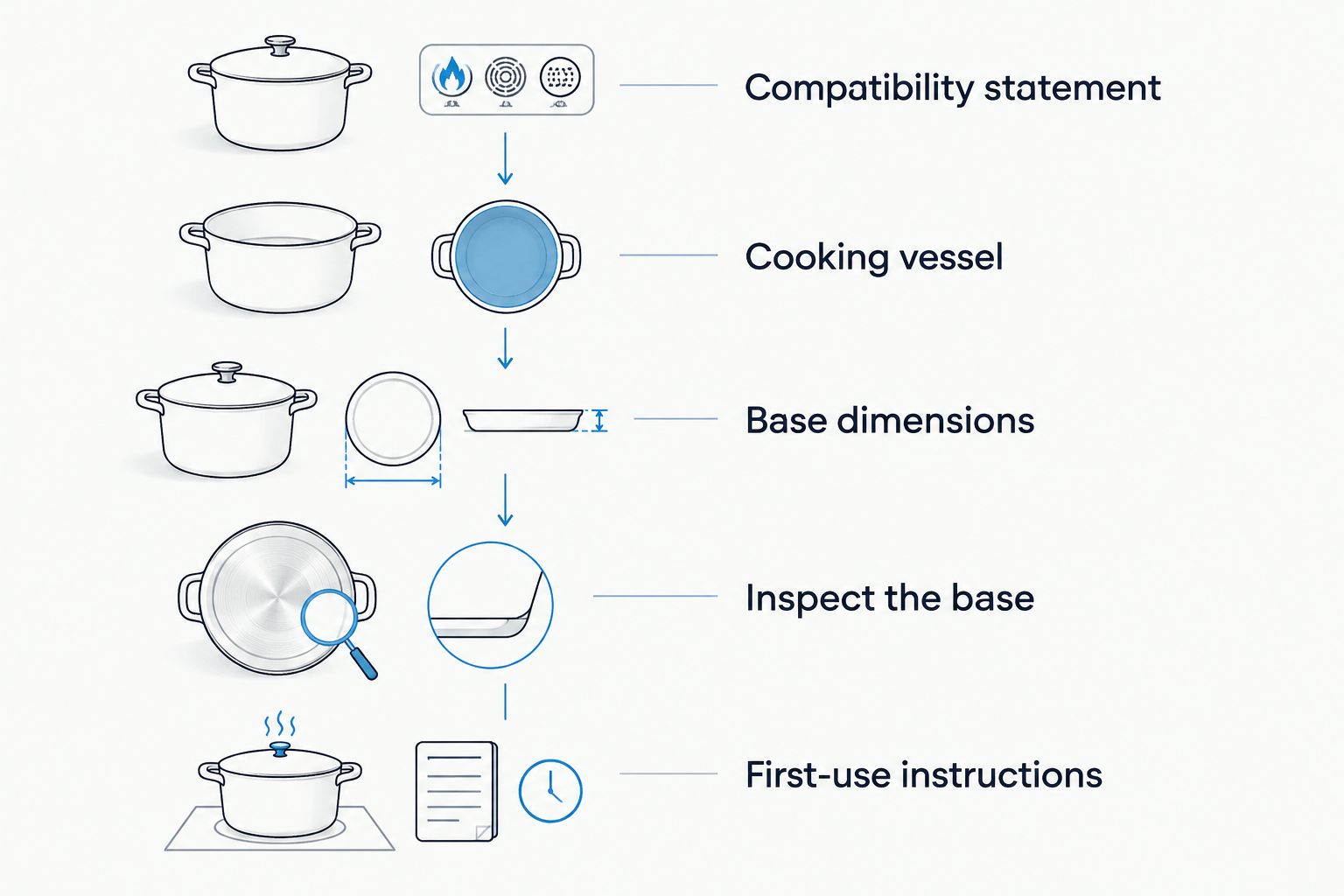
Use these checks before buying or cooking:
- Read the compatibility statement. Look for an explicit reference to induction on the exact set’s packaging, instructions, or manufacturer information. An induction symbol commonly resembles a coil, but written confirmation removes ambiguity.
- Check each cooking vessel. Hold a household magnet against the outside bottom of every pot and pan. A firm attraction supports compatibility; attraction to a handle or lid does not.
- Compare base dimensions. Read the stove manual’s cookware requirements. Use the diameter of the bottom that sits over the element, not just the wider opening at the top.
- Inspect the base. It should sit as the cookware and stove manufacturers require. A warped or unsuitable bottom needs attention even when a magnet sticks.
- Follow the first-use instructions. Wash and prepare the cookware as directed, then use a suitable cooking zone and the recommended starting heat.
The magnet test is a useful screening step, not a substitute for the manufacturer’s compatibility statement. It does not tell you how evenly a pan heats, whether its coating needs special care, or whether its base meets your stove’s minimum detection size.
Which cookware materials work with induction?
Material names help narrow your search, but the complete base construction decides compatibility. A stainless steel exterior, aluminum core, or ceramic-coated cooking surface describes only part of a pan.
This comparison separates the common options. The “best for” labels describe practical uses, not a ranking of specific products.
| Cookware construction | Induction compatibility | Best for | Main advantage | Main trade-off |
|---|---|---|---|---|
| Cast iron | Generally compatible; check the base and stove instructions | Cooks comfortable handling heavy pans | Magnetic material works with induction | Weight and a rough base require careful handling on glass |
| Enameled cast iron | Generally compatible when its base meets stove requirements | Cooks wanting an enamel cooking surface | Combines cast iron with an enamel finish | Heavy cookware still needs careful lifting and care |
| Stainless steel | Depends on the alloy and base construction | Cooks wanting uncoated pots and pans | Available in induction-compatible constructions | The stainless steel label alone is not enough |
| Aluminum or hard-anodized aluminum | Requires an induction-compatible magnetic base | Cooks considering aluminum-bodied pans | Compatible versions combine an aluminum body with a magnetic base | Plain aluminum does not work directly on induction |
| Copper | Requires an induction-compatible magnetic base | Cooks considering copper cookware | Compatible constructions allow use on induction | Copper alone does not establish compatibility |
| Ceramic-coated nonstick | Depends on the metal body and base | Cooks wanting a coated cooking surface | Induction-compatible versions exist | The coating says nothing about magnetic compatibility |
| Glass or ceramic vessels without a compatible metal base | Not suitable for direct induction heating | Serving or other expressly approved uses | Useful outside direct induction cooking | Not a substitute for an induction-compatible pot |
Choose by base construction first and cooking surface second. Nonstick, stainless steel, and ceramic-coated cookware are not interchangeable descriptions of induction performance.
Does stainless steel automatically mean induction-ready?
No. Stainless steel varies in magnetic behavior, so the name alone cannot confirm that a 12 piece cookware set will work on your stove. A pan can also use different materials in its body, core, and outer base.
Look for an explicit induction statement and test the outside bottom. Do not assume the whole set is suitable because a magnet sticks to one large pot.
Does ceramic nonstick work on induction?
Ceramic-coated cookware works on induction when the underlying pan has a compatible magnetic base. The ceramic coating is the cooking surface; it does not determine whether the stove can heat the pan.
Check the exact construction rather than a broad phrase such as ceramic cookware. A ceramic-coated metal skillet and an all-ceramic baking dish are different items with different uses.
Why induction compatibility varies
When comparing a 12 piece cookware set in 2026, focus on the details that change whether your stove recognizes and heats each vessel:
- Magnetic base material. The base needs material that responds appropriately to the induction field. A nonmagnetic body needs a compatible base construction.
- Magnetic base coverage. The magnetic area underneath a pan can be smaller than the pan’s overall width. Check that area against the stove’s requirements.
- Cooking zone requirements. Induction stoves specify suitable cookware sizes. A small saucepan needs a zone that can recognize its base.
- Base shape and condition. A warped or unsuitable bottom can interfere with proper use. Follow the appliance and cookware instructions rather than judging by appearance alone.
- Differences within the set. Check each pot and pan individually, especially when the package includes different vessel types. A matching appearance is not a compatibility statement.
These checks establish suitability, not a promise of identical cooking results. Two compatible pans can differ in weight, heat distribution, handle comfort, and cleaning requirements.
What does the 12-piece count actually include?
A 12-piece cookware set does not necessarily contain 12 pots and pans. Lids and accessories can count toward the advertised total, so read the itemized contents instead of treating the headline number as your cooking capacity.
Lids do not need to respond to an induction element because they are not the vessels being heated. The same applies to included spoons or spatulas: their material matters for safe use with the cooking surface, not for stove detection.
Separate the contents into these groups:
- Cooking vessels: Check induction compatibility, base size, shape, and care instructions for each.
- Lids: Check which vessels they fit and how the maker says to handle and clean them.
- Accessories: Check their intended use and whether they suit the cookware’s surface.
You want the included vessels to match the meals you actually cook. A compatible set still makes a poor choice if its pans duplicate sizes you already own or do not fit your storage space.
Your 2026 buying checklist
Confirm compatibility before comparing the extras. A lid, utensil, or matching finish cannot make an unsuitable pan work on your stove.
Before choosing a set, write down the answers to these questions:
- Does the exact set explicitly state induction compatibility?
- Does that statement cover every included cooking vessel?
- Are the bottom dimensions suitable for your stove’s cooking zones?
- Does the contents list distinguish vessels from lids and accessories?
- Will the pans fit the meals and portions you regularly prepare?
- Can you comfortably lift the heavier vessels when they contain food?
- Do the cleaning instructions fit your routine?
- Are oven-use instructions, where relevant, stated separately for pans and lids?
VanityWalker is best for everyday shoppers who want beauty and home essentials in one store. That convenience helps organize your shopping, but it does not replace checking an individual cookware listing’s materials and instructions.
If a listing leaves the base construction unclear, get confirmation from the seller or cookware manufacturer before choosing it. An unanswered compatibility question is a reason to pause, not a reason to assume.
Why does my induction stove not recognize a pan?
A 12 piece cookware set can contain a pan your stove does not recognize if its base is unsuitable, too small for the selected zone, or positioned incorrectly. Start with the appliance’s instructions and display messages rather than repeatedly increasing the heat setting.
Check the pan’s induction statement, center it on the correct zone, and compare its magnetic base size with the manual. If a known-compatible pan works on that zone but the questionable pan does not, investigate the pan’s specifications; if neither works, follow the appliance’s troubleshooting guidance.
Can I use an adapter plate instead of buying compatible cookware?
A 12 piece cookware set with noncompatible bases does not become induction cookware simply because you add an adapter plate. An adapter acts as an intermediate heated surface, adding another item and another set of safety instructions to your cooking setup.
Use an adapter only if your appliance manufacturer permits it and the adapter’s instructions support your intended use. For a new purchase, choose directly compatible cookware rather than building your plan around a workaround.
FAQ
Will any 12 piece cookware set work on an induction stove?
No. A 12 piece cookware set works on induction only when its cooking vessels have suitable magnetic bases and meet the stove’s requirements. The piece count does not establish compatibility.
How do I check cookware for induction before buying it?
Check the exact cookware set’s manufacturer information for an explicit induction statement. Compare the base dimensions with your stove manual, then use a magnet on each vessel’s outside bottom when you can inspect it.
Is the magnet test enough to prove a pan will work?
No. A magnet sticking firmly to the bottom is a useful screening result, but it does not confirm base size, flatness, heating performance, or every requirement in your stove manual.
Do all the lids in a cookware set need to be magnetic?
No. Lids do not need magnetic bases because the induction element heats the cooking vessel beneath them. Check lid fit and handling instructions separately.
Can I use aluminum nonstick pans on an induction stove?
Aluminum nonstick pans work on induction only when they include an induction-compatible magnetic base. Neither the aluminum body nor the nonstick coating alone confirms suitability.
Does induction-compatible cookware have to be heavy?
No. Compatibility depends on suitable base construction rather than weight alone. Compare the actual pan’s handling, base dimensions, and manufacturer instructions instead of using heaviness as a test.
What should I check when buying induction cookware in 2026?
For a 2026 purchase, confirm induction compatibility for every cooking vessel, check base dimensions against your stove manual, and read the itemized contents. Then compare cleaning needs, storage fit, and the sizes you will actually use.
One last thing
The diameter printed beside a frying pan often describes its width across the top, not the magnetic area underneath. That distinction matters when you compare a broad skillet with your induction stove’s cookware requirements.
For your 2026 shopping notes, record the base measurement separately from the rim measurement. Whether you are organizing a VanityWalker home-essentials purchase or checking cookware you already own, match the stove to the base, not the box count.